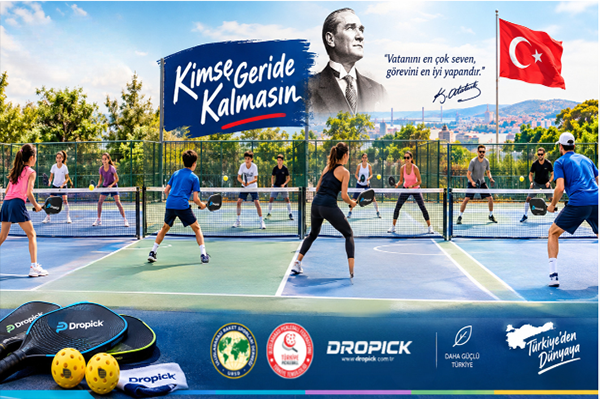
Türkiye appears on most lists of pickleball’s emerging markets, but the shape of its growth is more interesting than the raw numbers. The sport is not arriving through private racket clubs, which is broadly how it spread across North America. It is arriving through universities and municipalities.
Where the courts actually are
Of the dedicated court venues currently listed on PickleLiga, the pickleball platform, the largest single site is a university: Anadolu Üniversitesi in Eskişehir, with eight courts — three indoor, five outdoor. A municipal park in Muğla Menteşe carries three. The remainder are private clubs and municipal sports centres, including venues in Ankara, İstanbul and Manisa. Twenty courts across five cities.
That is a small base, and it is worth stating plainly rather than dressing up. But at this stage the ownership mix matters more than the count. University and municipal courts are public-access, low-cost and already attached to an institution with a budget line, which puts the price of a player’s first session close to zero. In markets where the sport arrived through membership clubs, that first session is the barrier that decides everything else.
Rating adoption is unusually deep for the stage
The more surprising figure is DUPR uptake. Of active players on the platform, 135 have linked a verified DUPR account — roughly 42%. Of those, 123 carry an issued rating and 12 are still NR, waiting on match volume.
For an emerging market that is high. Rating adoption in a young scene normally lags participation badly, because casual players see little reason to carry a number. It matters here because the competitive structure is being built directly on top of it: level-gated categories, balanced open-play rotations and tournament seeding all read the same verified rating instead of a self-declared skill level. A scene that adopts a shared rating early skips the years most markets spend arguing about who belongs in which bracket.
Competition is organising nationally, not locally
The 2026 season is structured as a multi-city team series rather than a scatter of unconnected weekend events. Muğla hosts on 3-4 October, with registration open at the time of writing; Balıkesir follows on 24-25 October; the finals land in İstanbul on 26-27 December.
The team format is the notable choice. Team competition requires a roster, a captain and a lineup decision before every tie — obligations that keep a group playing together between events. Individual tournaments produce entries. Team series produce clubs.
What transfers to other emerging markets
Three things look portable. Institutional venues lower the cost of a first session more effectively than marketing does. A shared rating adopted early removes the most corrosive recurring argument in recreational competition. And a national series gives local groups a reason to keep playing through the off-season.
The current venue map is visible through a public directory of pickleball courts, listed by city and court count. It is free for everyone to use.
Uluslararası Raket Sporları Derneği